
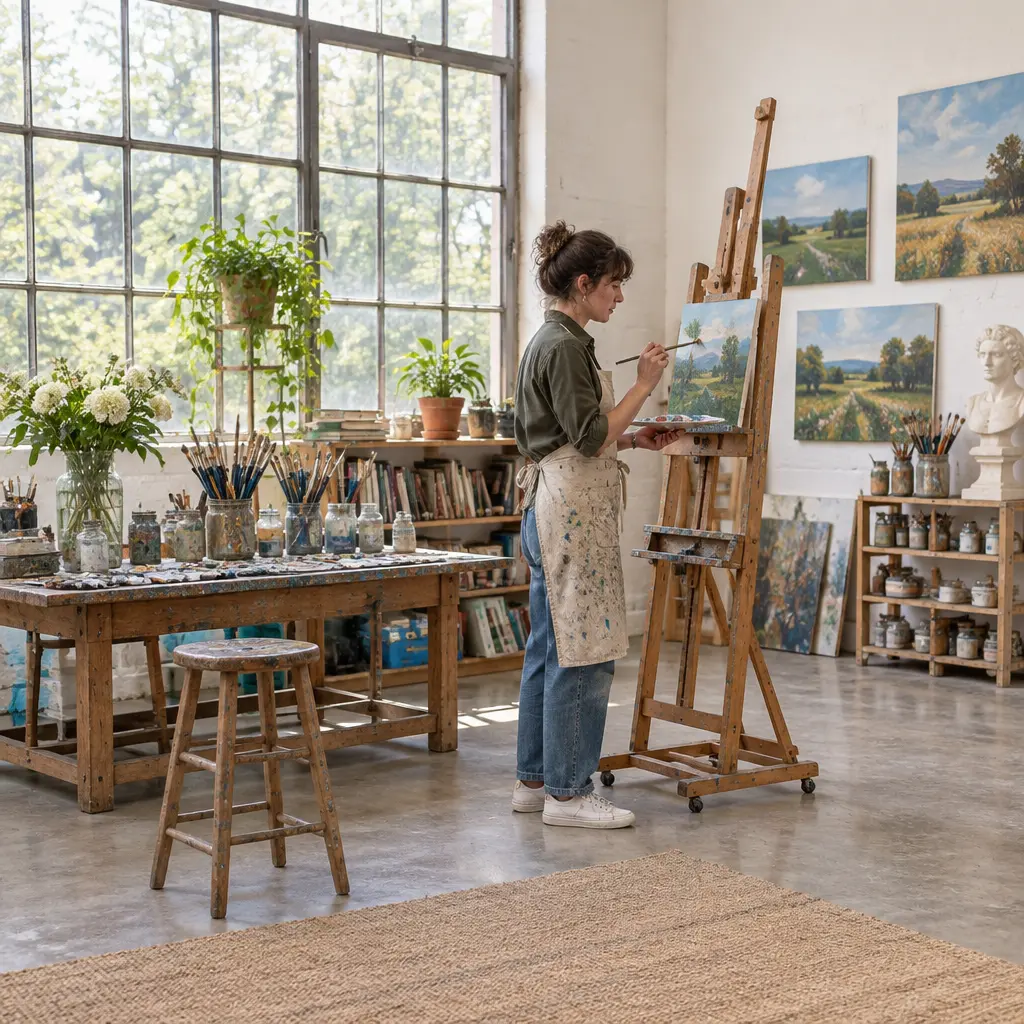
Painting technique is the set of choices and actions an artist uses to apply paint, control color, create form, and organize a composition. It is not simply an inborn gift: deliberate practice—focused work on a specific skill, supported by feedback and revision—can help painters build more reliable control. Research on expertise suggests that purposeful practice contributes to skilled performance, although it is not the only influence. This article explains how painters can practice brushwork, color, observation, and composition; how to structure exercises; and how to assess progress without treating hours alone as proof of mastery.
Deliberate practice develops painting technique
Deliberate practice means working toward a defined improvement through tasks that are challenging, repeatable, and followed by useful feedback. Psychologist K. Anders Ericsson and colleagues described it as structured practice designed to improve performance, rather than mere repetition. Applied to painting, the idea is to identify a weakness—such as muddy mixtures or inconsistent edges—then isolate and work on it before returning to a complete painting.
A frequently cited 1993 study by Ericsson, Ralf Krampe, and Clemens Tesch-Römer examined expert violinists and found differences in accumulated practice. It was not a study of painters, and its results do not establish a fixed number of hours required to become an artist. A 2014 meta-analysis by Brooke Macnamara, David Hambrick, and Frederick Oswald likewise found that deliberate practice explained a meaningful but limited share of performance differences across fields. The careful takeaway is that practice matters, but talent, prior experience, instruction, motivation, and opportunity matter too.
Painting practice can be grouped into related areas: technical exercises for handling materials, perceptual exercises for seeing accurately, and integrated projects that combine those abilities. Moving between these categories helps prevent isolated drills from becoming disconnected from actual artistic decisions.
Goal-directed exercises
A goal-directed exercise targets one observable outcome. Instead of “get better at painting,” a painter might aim to mix five distinct values from one hue or paint a sphere using only three value groups. Keeping the task narrow makes it easier to notice whether a change in method improves the result.
Useful practice prompts include painting the same simple object under different lighting, making a series of controlled brushstroke marks, or matching a small set of reference colors. A short note after each session—what worked, what did not, and what to try next—turns an exercise into a learning cycle.
Feedback and revision
Feedback is information that helps a painter compare an attempt with a goal. It can come from a teacher, a peer, a photograph of the work, or a direct comparison with a reference. Feedback is most useful when it identifies a specific issue, such as a perspective error or a value that is too light, rather than offering only general praise or criticism.
Revision makes feedback actionable. A painter can correct one passage, repeat the study, or make a second version under the same conditions. Comparing versions helps reveal whether the adjustment improved the intended feature while preserving other parts of the image.
Brush control and paint handling improve through repetition
Brush control is the ability to direct a mark’s shape, width, pressure, and edge. Paint handling includes choosing how much pigment, water, medium, or solvent to use and how to place layers. These skills depend on the medium: watercolor rewards careful management of water and timing, while oil and acrylic allow different approaches to layering, blending, and correction.
Mark-making and pressure
Mark-making practice develops the ability to produce a chosen stroke consistently. A simple sheet of drills can include straight lines, curves, broad strokes, tapered strokes, and marks made with the brush’s tip and side. The aim is not to make every stroke identical, but to gain more control over the choices available.
Artists can vary pressure, angle, speed, and brush loading one factor at a time. For example, making a row of strokes with the same brush and paint but changing pressure helps isolate how pressure affects width. This kind of controlled comparison is more informative than changing several variables at once.
Edges, layers, and medium-specific control
An edge is the boundary between shapes or values. Hard, soft, and lost edges guide attention and help describe form. Painters can practice edges by painting simple overlapping shapes, deliberately creating one crisp boundary, one blended boundary, and one boundary that merges into its surroundings.
Layering exercises should match the material. In watercolor, painters can test washes, drying time, and the effects of layering transparent color. With acrylic, studies can explore how quickly a layer dries and how opaque or transparent applications affect the surface. Oil painters can practice controlling thin and thicker applications while following sound material and studio-safety guidance. These are not interchangeable recipes: product instructions and appropriate ventilation matter.
Color and value studies strengthen visual decision-making
Color technique involves mixing and placing hues to serve a painting’s form, light, and mood. Value is the relative lightness or darkness of a color. Because color relationships can be difficult to judge in isolation, painters often simplify a subject into a limited palette or a grayscale study before tackling a more complex image.
Value grouping
Value grouping means organizing light and dark areas into a small number of readable families. A painter might reduce a reference to three broad groups—light, middle, and dark—before adding detail. The exercise trains attention on the overall pattern rather than on small features.
A practical check is to view a study from a distance or photograph it in grayscale. If the subject’s major forms remain legible, the value structure is likely doing useful work. This test is a studio aid, not a universal measure of artistic quality.
Limited palettes and color mixing
A limited palette restricts the number of paints used, encouraging the artist to understand relationships among hue, value, and saturation. A mixing chart can record combinations and proportions, making it easier to reproduce a color or diagnose why a mixture became dull.
Painters can also practice matching a few colors from life or a reference, then compare the mixtures under consistent lighting. Since screens, room lighting, and paint brands can alter perceived color, the purpose is to improve observation and repeatability—not to assume there is one universally exact mixture.
Observation and composition turn exercises into paintings
Technical control is more useful when connected to observation: the act of comparing proportions, angles, shapes, and relationships rather than relying only on assumptions about what an object “should” look like. Composition organizes those elements within the picture plane. Together, these skills help a painter make studies that communicate a clear visual idea.
Drawing, proportion, and visual measurement
Visual measurement uses comparisons—such as the width of one form relative to its height—to place shapes more accurately. Before adding paint, a painter can make a small drawing, check angles, and compare negative spaces, the shapes formed between and around objects. These steps can reveal structural errors early, when they are less costly to correct.
A focused exercise might use a simple still life and a limited painting time. The painter first records the largest shapes, then checks their relative sizes, and only afterward adds color and detail. Repeating the setup makes it possible to see whether observation improves across attempts.
Composition thumbnails and complete studies
A thumbnail is a small, simplified composition sketch. Making several thumbnails before a larger work lets the painter compare focal point, balance, and major light-dark patterns without investing time in surface detail. The process also connects individual techniques to the larger purpose of the painting.
Complete studies are important because isolated drills cannot fully reproduce the decisions involved in a finished image. After practicing a skill separately, painters can apply it in a small painting and review whether it supported the composition. A still-life series, for example, can keep the subject and lighting consistent while the painter focuses on different goals in each version.
A sustainable practice plan makes progress visible
A sustainable plan balances focused drills, finished studies, reflection, and rest. There is no research-established schedule that guarantees mastery for every painter. The best plan is one that fits the artist’s time, materials, experience, and access to feedback, while making goals concrete enough to assess.
Structure a session around one priority
A practice session can begin with a brief warm-up, continue with one targeted exercise, and end with a review. For instance, a painter might use the session to improve soft edges: make a few controlled tests, apply the skill in a small study, then record which conditions produced the clearest result.
A simple log can track the date, goal, exercise, observations, and next step. This makes progress easier to judge across weeks than relying on memory or the emotional impression of a single session. Photos taken from a consistent distance and under similar lighting can also support comparisons.
Use examples without copying blindly
Studying another artist’s work can reveal decisions about edges, layering, value, or composition. A useful study asks a specific question—such as how the painter simplified a complex shadow—and then tests that idea in a separate exercise. Copying without analysis may reproduce surface effects without building understanding.
Museum visits, instructor demonstrations, and close study of paintings can provide context that photographs may miss, including scale and surface. When working from contemporary artists’ images, painters should respect copyright and use references in ways permitted by the rights holder and applicable law.
Conclusion: painting technique is learned through purposeful work
Deliberate practice makes painting improvement more intentional by linking a clear goal with focused exercises, useful feedback, and revision. Brush control and paint handling build material fluency; value and color studies sharpen visual choices; observation and composition connect those skills to complete paintings. Research on expertise supports practice as an important contributor to performance, while cautioning against reducing achievement to hours or a single formula.
Choose one painting problem to address in your next session, make a small study, and record what you learn. For further reading, consult Ericsson and colleagues’ work on deliberate practice, Macnamara and colleagues’ meta-analysis of practice and performance, and reputable museum or art-school resources on the medium you use.
Sources: K. Anders Ericsson, Ralf T. Krampe, and Clemens Tesch-Römer, “The Role of Deliberate Practice in the Acquisition of Expert Performance,” Psychological Review, 1993, https://doi.org/10.1037/0033-295X.100.3.363; Brooke N. Macnamara, David Z. Hambrick, and Frederick L. Oswald, “Deliberate Practice and Performance in Music, Games, Sports, Education, and Professions: A Meta-Analysis,” Psychological Science, 2014, https://doi.org/10.1177/0956797614535810

