
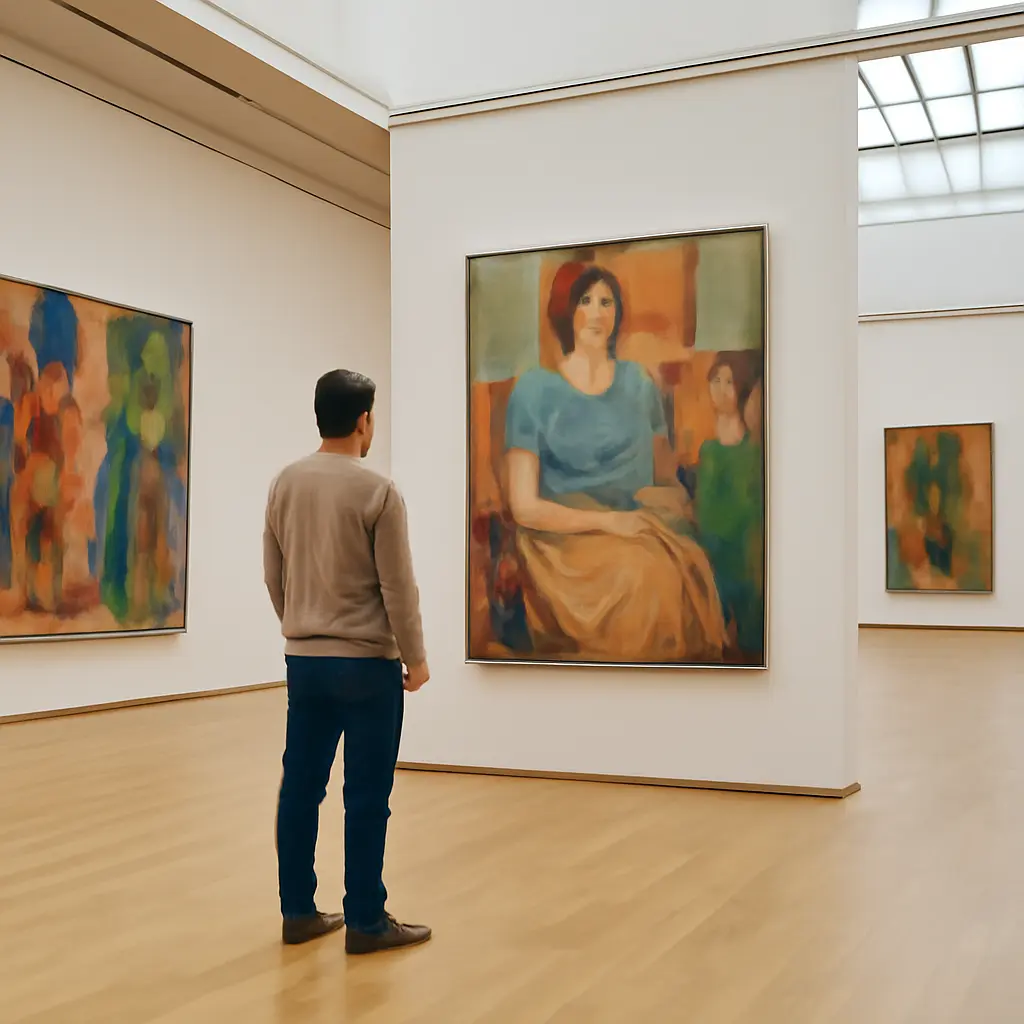
Figurative painting—the depiction of recognizable people and bodies—has not returned from extinction; it has regained visibility within a contemporary art world that long emphasized abstraction, conceptual practice, and digital media. The evidence is not one definitive industry-wide statistic, but a convergence: major museums are presenting contemporary painters, galleries and art fairs continue to exhibit image-based work, and artists are using the human figure to address identity, race, gender, memory, and technology. The renaissance is therefore best understood as a lively, plural movement rather than a single school, with roots in older traditions and fresh momentum in studios, exhibitions, and the market.
Contemporary Figurative Painting describes a renewed focus on the recognizable human subject
“Figurative painting” is a broad term for painting that represents recognizable forms, especially the human body, rather than dispensing with recognizable subject matter. The Museum of Modern Art’s collection and educational materials distinguish representational art from abstraction while showing that the categories often overlap: artists may retain a figure but distort, simplify, or fragment it. In current practice, contemporary figurative painting describes work in which recognizable bodies or faces remain central, even when color, scale, composition, or narrative is unconventional.
That definition matters because the current moment is not a simple reversal of modernism. Figurative painters often borrow abstraction’s freedom of color and form, photography’s cropping, and digital culture’s rapid circulation of images. Their paintings can be realistic, dreamlike, politically direct, or deliberately unresolved. What connects them is not one style but the decision to make the figure carry meaning.
Figuration is a method, not a uniform look
A figurative work need not be anatomically accurate or conventionally realistic. The figure might be flattened, elongated, loosely painted, or placed in an impossible setting. Art historians and museum curators commonly use “figuration” to describe the presence of identifiable forms, while “realism” more narrowly suggests an effort to depict appearance or lived experience. This distinction helps explain why a painter can be figurative without being photorealistic.
The category includes portraiture, the nude, domestic scenes, historical painting, and narrative scenes, as well as hybrid forms that combine these genres. These are useful subcategories, not sealed compartments: a portrait can also function as social commentary, and a domestic scene can become a meditation on memory or power.
A renaissance means renewed attention, not a first appearance
Figurative painting has never disappeared. Artists continued to paint bodies through periods when abstraction and conceptual art received greater critical attention. The word “renaissance” here describes renewed public and institutional visibility, not a clean break in art history. The persistence of figurative work is clear in the long careers of painters such as Alice Neel and Kerry James Marshall, whose practices show that contemporary interest builds on generations of artists rather than emerging from nowhere.
Contemporary figurative painting gains momentum through institutions, markets, and audiences
No single reliable statistic measures the global popularity of figurative painting. Art-market reports track sales by medium, price bracket, or region, but generally do not isolate “figurative painting” as a consistent category. Still, several indicators help document the wider environment: museums have expanded attention to living artists and underrepresented histories; art fairs and commercial galleries regularly feature painters; and auction and gallery coverage has made new figurative practices more visible to collectors and the public.
The Art Basel and UBS Art Market Report, prepared by economist Clare McAndrew, estimated global art-market sales at $65 billion in 2023, down 4% from 2022. That figure describes the entire art market—not figurative painting alone—and should not be mistaken for proof of a medium-specific boom. It does, however, show that painting operates within a substantial international ecosystem of galleries, collectors, fairs, and institutions.
Museums have widened the historical frame
Museum exhibitions and acquisitions help make contemporary figurative art legible by placing it in conversation with art history. The Metropolitan Museum of Art’s collection and exhibition programming, for example, connect present-day work to centuries of portraiture, history painting, and representations of the body. Institutions such as the National Gallery of Art and the Museum of Modern Art also preserve the contrast and exchange between figuration and abstraction, rather than treating them as mutually exclusive camps.
This institutional context is important because many current painters revise inherited conventions. They ask who has historically been permitted to represent the body, whose likeness has been collected, and whose stories have been left out of dominant accounts. Museum attention can broaden those accounts, although exhibition visibility alone does not resolve inequalities in acquisition, representation, or critical recognition.
The art market signals interest but does not define artistic value
Commercial attention can amplify a movement, but prices and sales are imperfect measures of cultural importance. Art Basel and UBS reported that dealer sales reached an estimated $36.1 billion in 2023, while auction sales fell amid a more cautious market. These figures reflect changing economic conditions across many media and artists. They cannot establish that figurative painting itself is growing at the same rate.
Collectors’ interest in recognizable imagery may help paintings travel beyond specialist audiences, but the strongest case for a renaissance is qualitative as well as commercial: painters are making distinctive work, institutions are giving it sustained attention, and viewers are debating what bodies and identities mean in public life.
Contemporary figurative painting takes several distinct forms
The renewed visibility of figurative painting is easier to understand by separating its overlapping approaches. Portraiture, social figuration, narrative painting, and hybrid image-making share an interest in recognizable people, but they use the figure for different purposes. Together, they show why the movement is diverse rather than stylistically uniform.
Portraiture makes identity and presence visible
Contemporary portraiture depicts individuals while also examining how identity is constructed and perceived. Artists may use direct eye contact, unusual scale, expressive brushwork, or invented settings to resist the idea that a portrait is merely a likeness. Kehinde Wiley, for instance, places contemporary sitters within compositions that recall European portrait traditions, redirecting the authority and visual language of historical images.
Portraiture’s relevance is reinforced by the expanding debate about representation in museums and public culture. The National Portrait Gallery’s collections and exhibitions demonstrate how portraiture can record individuals while also shaping national narratives. A contemporary portrait can therefore function as an encounter with a person and a question about who is granted visibility.
Social figuration connects bodies to lived conditions
Socially engaged figurative painting places people within settings shaped by class, race, gender, labor, migration, or community. Kerry James Marshall’s paintings, for example, center Black subjects within the scale and visual ambition historically associated with canonical history painting. His work demonstrates how representation can be both formal and political: the composition asks viewers to consider who occupies the center of art history.
This approach also appears in scenes of ordinary life. A kitchen, street, bedroom, or gathering can become a record of intimacy and social structure. The body is not an isolated symbol; it is situated in a world of relationships, objects, and histories.
Narrative and psychological painting turn scenes into open-ended stories
Narrative figurative painting presents people in situations that imply events, relationships, or inner states without necessarily explaining them. Artists may draw on personal memories, literature, photographs, or imagined scenes. The viewer becomes an interpreter, searching gestures and settings for clues rather than receiving a fully resolved plot.
The approach is visible in the work of painters such as Peter Doig, whose landscapes and figures often combine observation with dreamlike ambiguity, and Lynette Yiadom-Boakye, who paints invented sitters in evocative, non-specific settings. Such work demonstrates that recognizability does not require documentary certainty.
Hybrid figuration absorbs photography and digital image culture
Hybrid figurative painting combines recognizable subjects with visual habits drawn from photographs, film, advertising, and social media. Cropped compositions, abrupt changes in scale, staged poses, and vivid color can make a canvas feel familiar to viewers accustomed to screens while retaining the material presence of paint.
This relationship is not simply a competition between painting and digital media. The National Endowment for the Arts’ research on arts participation tracks changing ways Americans encounter art, including through digital channels. Online circulation can introduce viewers to painters, while the physical scale, surface, and labor of a painting offer an experience that a screen image cannot fully reproduce.
Contemporary figurative painting revises art history while preserving the power of the body
The figure has been central to art for millennia, but its meanings have never been fixed. Renaissance artists used anatomy and perspective to organize religious and civic narratives; modernists altered bodies to challenge inherited ideas of representation; contemporary painters inherit both traditions while questioning their exclusions. The present moment is significant because it treats the figure as a site where history, identity, and visual experimentation meet.
Historical painting supplies a language that artists can challenge
Historical portraiture and history painting established conventions of scale, pose, costume, and prestige. Contemporary artists can quote these conventions, alter them, or refuse them. Wiley’s reworking of grand portrait formats is one clear example; Marshall’s expansive scenes similarly make visible people often marginalized in traditional accounts of monumental painting.
These interventions show why figurative painting can be both accessible and intellectually demanding. Viewers recognize bodies and settings, but the work can prompt them to reconsider the historical systems that shaped those images.
The painted surface offers a counterpoint to instantly circulating images
In an image-saturated culture, painting’s slow, physical process can create a different kind of attention. Brush marks, revisions, texture, and scale remain visible as evidence of decisions made over time. The National Gallery of Art’s materials on painting conservation describe how supports, pigments, and techniques affect a work’s appearance and preservation, underscoring that a painting is not only an image but also a material object.
That material quality does not make painting inherently superior to photography or digital art. Rather, it gives figurative painters another way to explore how images are made, remembered, and trusted. A painted face may look familiar while revealing the artist’s interpretation through every mark.
Contemporary figurative painting’s renaissance is plural, durable, and still unfolding
The current renaissance of figurative painting is best understood as renewed visibility across several connected practices: portraiture, social figuration, narrative scenes, and hybrid image-making. Museums and galleries provide platforms, the international art market supplies one imperfect measure of attention, and artists use recognizable bodies to question inherited histories and contemporary identities. Available market statistics describe the larger art economy, not a precise figurative-painting boom, so claims about growth should remain measured.
The broader implication is that figurative painting remains capable of change. It can preserve likeness, invent stories, address political realities, and test the limits of representation without choosing between tradition and innovation. Readers can explore the subject further by comparing museum collections with current exhibitions, reading artists’ interviews, and looking closely at how contemporary painters transform historical genres. The renaissance is not a return to an old standard; it is an ongoing argument about who is seen, how people are portrayed, and what painting can still do.
Sources: The Museum of Modern Art, “What Is Modern Art?”, https://www.moma.org/learn/moma_learning/themes/what-is-modern-art/; Art Basel and UBS, The Art Market 2024, https://www.artbasel.com/about/initiatives/the-art-market; The Metropolitan Museum of Art, Heilbrunn Timeline of Art History, https://www.metmuseum.org/toah/; National Gallery of Art, Collection and Conservation resources, https://www.nga.gov/; National Portrait Gallery, Collection, https://npg.si.edu/; National Endowment for the Arts, Arts Data Profile, https://www.arts.gov/impact/research/arts-data-profile-series.

