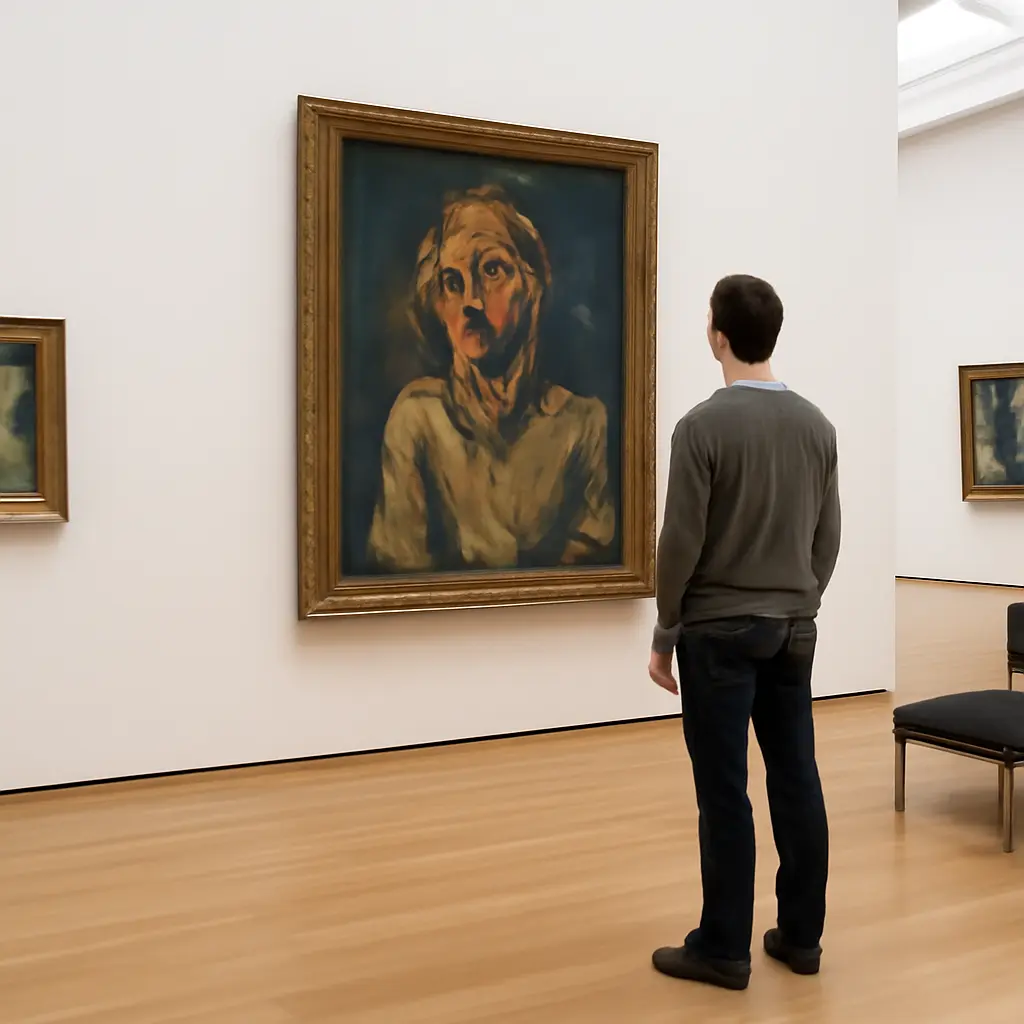
Exaggerated emotion in painting is the deliberate intensification of facial expression, gesture, color, scale, or composition to make feeling more visible and immediate. Rather than simply recording what a person looks like, artists use distortion and heightened visual cues to suggest what an experience feels like. From the anguished figures of Expressionism to the compressed tension of Edvard Munch’s The Scream, such choices can turn private emotion into a force viewers confront directly. This article explains how emotional exaggeration works, traces its historical and psychological relevance, examines major visual techniques and examples, and offers ways to read these paintings without mistaking intensity for a literal record of the artist’s state of mind.
How exaggerated emotion gives painting psychological power
Exaggerated emotion in paint is a representational strategy: an artist amplifies selected visual features so that a feeling becomes legible, memorable, or unsettling. Art historian Ernst Gombrich described artistic representation as a process shaped by conventions and expectations, not merely a neutral copy of nature. That distinction helps explain why a painted face may be more twisted, a color more acidic, or a gesture more expansive than its real-world equivalent. The exaggeration is purposeful, even when it appears spontaneous.
Its importance lies in the way painting communicates before viewers have fully named what they see. A clenched hand, a slanted horizon, or a violently contrasting palette can generate tension through visual form. The American Psychological Association’s research summaries on emotion and perception describe how affect can influence attention and interpretation; in art, this means that emotional cues may guide a viewer toward certain details and shape the overall reading of a scene. This is not a universal formula—responses depend on culture, experience, and context—but it helps explain why heightened imagery can feel so immediate.
The scale of the subject is substantial: the National Endowment for the Arts’ 2022 Survey of Public Participation in the Arts reported that 26.7% of U.S. adults visited an art exhibit or gallery in the preceding year. That figure does not measure reactions to emotionally intense paintings, but it illustrates the continuing public reach of visual art. A useful visual guide would compare a naturalistic face with an expressionistically distorted one, labeling changes in mouth, eyes, posture, color, and surrounding space.
Amplification defines the raw psychological power of exaggerated emotion in paint
In this context, “amplification” means the selective intensification of visual signs associated with feeling. The art historian and critic Robert Rosenblum, writing about modern art, emphasized how artists such as Edvard Munch transformed observed experience into expressive form rather than relying on strict naturalism. Amplification can involve distortion, but it can also arise from repetition, scale, contrast, or omission. A painting may enlarge one emotional cue while simplifying others, directing attention to the feeling the artist wants to foreground.
Common forms include facial distortion, expressive gesture, symbolic color, disrupted space, and compressed or fragmented bodies. These devices often work together: an anguished face gains force when the surrounding landscape also seems unstable. The bridge from this general definition to the painting’s specific techniques is the viewer’s act of interpretation: each visual choice offers a cue, while the whole composition determines how those cues combine.
Facial distortion makes inner conflict visible
Facial distortion is the intentional alteration of features—such as widening the eyes, tightening the mouth, or elongating the face—to intensify a perceived emotion. It does not function as a scientific diagnostic tool; rather, it uses recognizable signals that viewers may interpret as fear, grief, anger, or strain. Charles Darwin’s 1872 study The Expression of the Emotions in Man and Animals compared expressive behaviors across humans and animals, establishing an influential early framework for studying visible emotion, though later research has challenged the idea that facial expressions have fixed meanings in every culture and situation.
In Munch’s The Scream (1893), the central figure’s hollowed face and open mouth seem to embody alarm, while the wavering sky and slanting landscape extend that disturbance beyond the body. The figure is not simply a portrait of a person displaying fear; the entire painted world appears to participate in the emotional event. This is why facial exaggeration is most powerful when supported by composition and setting.
Gesture and posture turn emotion into movement
Expressive gesture is the use of body position, direction, and movement to communicate psychological pressure. A hunched back can suggest withdrawal, while a raised arm can imply protest, appeal, or panic. In Francisco Goya’s The Third of May 1808 (1814), the central figure’s outstretched arms form a dramatic, almost cruciform shape against the firing squad. The pose makes vulnerability visible and gives the scene a moral as well as emotional emphasis.
Gesture can also be exaggerated through repeated or angular forms. In Ernst Ludwig Kirchner’s street scenes, sharply bent figures and crowded bodies convey the strain and anonymity of modern urban life. These examples show how bodily exaggeration can move from an individual emotion to a broader social atmosphere.
Color heightens emotional temperature
Expressive color is color chosen for its visual and emotional force rather than for literal accuracy alone. Bright red may intensify danger or urgency; green and yellow may create unease when used in discordant combinations; a field of deep blue can suggest distance, melancholy, or calm depending on its context. These associations are not universal codes. They are shaped by culture, surrounding colors, subject matter, and the viewer’s own experience.
In Vincent van Gogh’s The Night Café (1888), intense reds and greens create a deliberately oppressive atmosphere. Van Gogh wrote to his brother Theo that he wanted to express “the terrible passions of humanity” through the work’s colors. His statement offers direct evidence that color was being used as an emotional instrument, not merely as a record of the café’s appearance. A chart accompanying an illustrated article could identify the painting’s dominant complementary contrasts and explain how they contribute to its unease.
Distorted space makes the world feel unstable
Spatial distortion occurs when perspective, scale, or the environment is altered to reinforce a psychological effect. A tilted horizon can unsettle the viewer; compressed depth can make figures feel trapped; an oversized object can dominate the scene like a looming thought. In The Scream, curving lines and a skewed bridge make the landscape seem to echo the figure’s distress. The setting becomes an active participant in the painting rather than a neutral background.
Such distortions connect emotional painting to broader modernist experiments. Artists increasingly treated visual space as something that could express perception, memory, or anxiety rather than obey a single, stable viewpoint. This shift leads naturally from individual techniques to the historical movements that made emotional intensity a central artistic aim.
Expressionism and related movements made emotional distortion a central method
Expressionism is a broad modern-art tendency in which artists emphasize subjective experience through distortion, vivid color, and forceful form. The term is associated particularly with early twentieth-century artists in Germany and northern Europe, though expressive approaches appeared in many places and periods. The Museum of Modern Art’s account of German Expressionism highlights the movement’s rejection of conventional naturalism in favor of art that conveyed inner states and social realities.
Expressionism is not the only tradition to intensify emotion. Baroque painting often used dramatic light, bodily movement, and theatrical composition; Romantic art explored awe, terror, and the sublime; later movements such as Fauvism and Abstract Expressionism made color and gesture increasingly independent of literal description. These related approaches differ in purpose and style, but each demonstrates that exaggeration can be a structured visual language rather than a failure of realism.
Romanticism used the sublime to magnify fear and awe
The sublime describes an experience of overwhelming scale or power that can combine fear, wonder, and admiration. In Romantic painting, storms, mountains, shipwrecks, and vast landscapes often make human figures appear small and vulnerable. J. M. W. Turner’s The Slave Ship (1840), with its violent sea and glowing atmosphere, uses dramatic color and turbulent movement to confront viewers with both natural force and the horror of the slave trade.
The painting’s emotional force depends on more than spectacle: its subject links visual intensity to a specific historical crime. This is a reminder that heightened emotion can carry ethical and political meaning, not only personal feeling.
German Expressionism linked psychological strain with modern life
German Expressionism developed amid rapid urbanization, social change, and political tension in the early twentieth century. Groups such as Die Brücke, founded in Dresden in 1905, used sharp outlines, compressed forms, and intense color to challenge academic conventions. Kirchner’s crowded city scenes often make modern life feel emotionally charged, revealing how exaggerated form can represent collective unease as well as an individual’s state of mind.
The movement’s importance is not that every work depicts distress, but that it legitimized subjective distortion as a serious artistic method. That legacy can be seen in later figurative painting, film, illustration, and visual storytelling, where altered form remains a way to make interior experience visible.
Modern and contemporary artists extend expressive exaggeration
Later artists adapted emotional exaggeration to new subjects and styles. Francis Bacon’s distorted figures, for example, transform the human body into a site of vulnerability and pressure. Contemporary painters may combine expressionist distortion with references to popular media, identity, conflict, or mental health. Their work demonstrates that expressive exaggeration is not limited to one period: it changes as artists respond to the concerns of their own societies.
Because contemporary work often draws on multiple traditions, viewers benefit from distinguishing what is visibly exaggerated from what they infer about its meaning. The next step is to consider how viewers can interpret such paintings carefully, without reducing them to simple emotional labels.
Close looking helps viewers interpret exaggerated emotion responsibly
Reading an emotionally intense painting means examining how its parts work together before deciding what it “means.” A useful approach is to identify the subject, describe the visible choices, notice the viewer’s own response, and then consult historical context. The National Gallery of Art’s teaching resources encourage close looking and evidence-based interpretation, an approach that helps separate observable details from assumptions.
- Describe what is visible: posture, facial features, color, line, scale, and spatial arrangement.
- Ask which elements are exaggerated and what they direct attention toward.
- Consider whether the emotional effect belongs to one figure, the whole scene, or both.
- Check the work’s date, subject, and historical setting before making claims about its message.
- Keep interpretation open: the same visual cue may prompt different responses among viewers.
This method also discourages a common mistake: treating a painting as a transparent record of an artist’s private psychology. A work may express personal experience, but it is also shaped by artistic choices, cultural symbols, patrons, materials, and audience expectations. Emotional intensity is evidence of a constructed visual effect; by itself, it does not establish a diagnosis or a complete account of the artist’s life.
Conclusion: exaggerated emotion makes inner experience publicly visible
The raw psychological power of exaggerated emotion in paint comes from the way amplification turns visual form into an experience of feeling. Facial distortion, gesture, expressive color, and unstable space can make emotion palpable, while Romanticism and Expressionism show how these methods have served both individual and social subjects. Careful interpretation combines close looking with historical context and avoids treating a painting as a literal psychological report.
To explore the topic further, compare works by Munch, Goya, Van Gogh, Turner, and Kirchner, noting how each artist uses different visual cues to shape a viewer’s response. Visit a gallery or museum collection, read its curatorial notes, and test your first impression against what the painting actually shows. That practice reveals not only how artists exaggerate emotion, but also how viewers participate in making meaning.
Sources: National Endowment for the Arts, 2022 Survey of Public Participation in the Arts, https://www.arts.gov/impact/research/arts-data-profile-series/adp-32; American Psychological Association, Emotion, https://dictionary.apa.org/emotion; Ernst Gombrich, Art and Illusion: A Study in the Psychology of Pictorial Representation, https://press.princeton.edu/books/paperback/9780691169842/art-and-illusion; Charles Darwin, The Expression of the Emotions in Man and Animals, https://darwin-online.org.uk/; The Metropolitan Museum of Art, Vincent van Gogh: The Night Café, https://www.metmuseum.org/art/collection/search/436524; Museum of Modern Art, German Expressionism, https://www.moma.org/learn/moma_learning/themes/german-expressionism/; Tate, J. M. W. Turner, The Slave Ship, https://www.tate.org.uk/art/artworks/turner-slave-ship-n00520; National Gallery of Art, Teaching Critical Thinking Through Art, https://www.nga.gov/learn/teachers/lessons-activities/teaching-critical-thinking-through-art.html