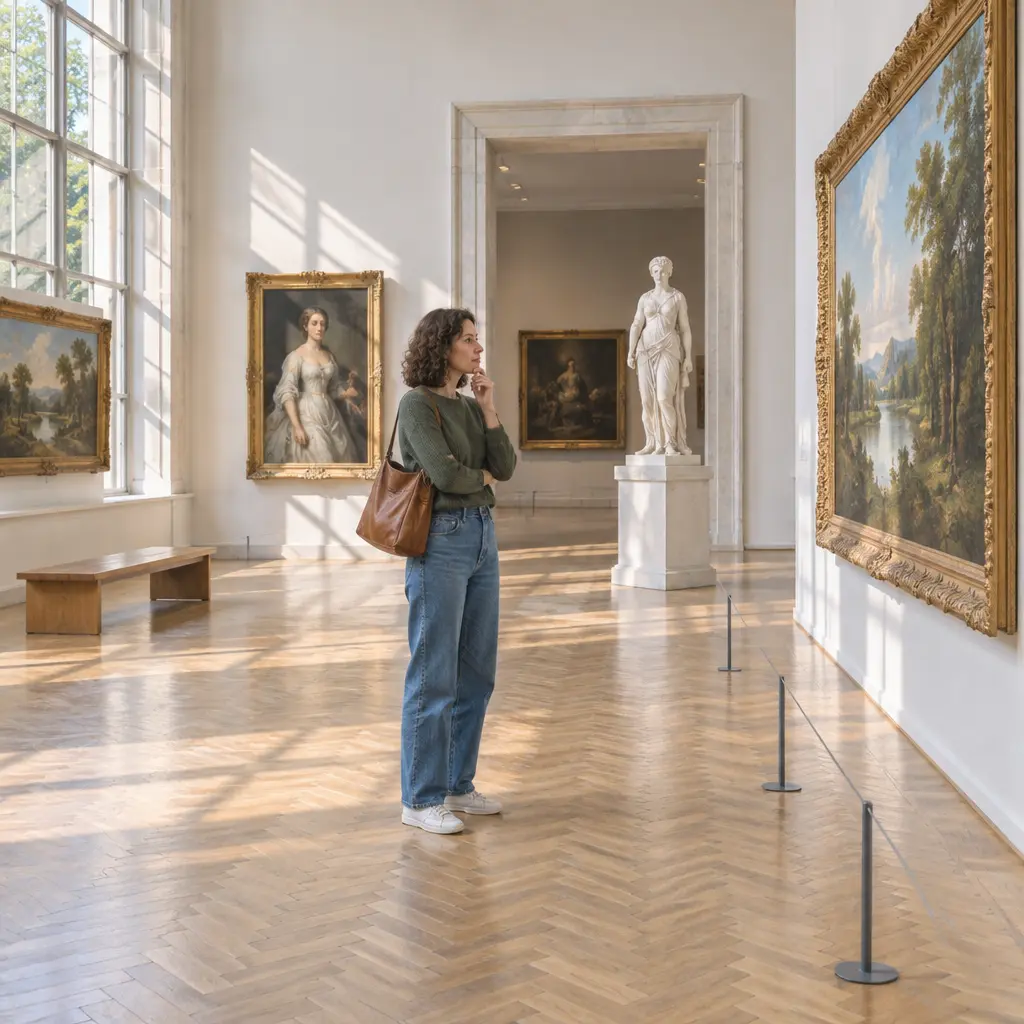
A museum guide designed for deep engagement helps visitors build meaning through close looking, questions, stories, and reflection rather than rushing through a checklist of famous objects. This approach aligns with museum learning research: a major study by the Institute for Learning Innovation found that visitors’ experience of exhibitions is shaped by personal, social, and physical contexts, while a 2018 study published in Visitor Studies found that open-ended questions can encourage more sustained engagement with artworks. Deep-engagement guides therefore combine visitor choice, accessible interpretation, manageable pacing, and opportunities to connect collections with personal experience. Their value is especially clear in a sector serving billions of visits worldwide: UNESCO has estimated that museums receive about 8.5 billion visits annually, making the quality—not simply the quantity—of those encounters consequential.
Define Deep-Engagement Museum Guides as Visitor-Centered Interpretation
A deep-engagement museum guide is a printed, digital, audio, or human-led interpretive tool designed to help visitors observe closely, form questions, make connections, and reflect. The American Alliance of Museums describes interpretation as a central part of a museum’s public service: it connects collections and expertise with visitors’ interests and experiences. In this article, “deep engagement” means more than spending longer in a gallery; it means attending to an object, developing an interpretation, and having a reason to revisit or discuss what was seen.
This is not a single standardized museum term. It is a practical design approach supported by established frameworks, including John H. Falk and Lynn D. Dierking’s Contextual Model of Learning. Their model explains that museum learning emerges through interactions among personal context, social context, and the physical setting. A guide that acknowledges those contexts gives visitors room to choose, talk, pause, and interpret rather than prescribing one fixed route or a required list of objects.
Close Looking and Open-Ended Questions
Close-looking prompts invite visitors to examine visible evidence before reading an authoritative explanation. Instead of asking visitors to identify an object’s “correct” meaning, a guide might ask, “What details do you notice first?” or “What makes you think the figure is moving?” This method connects naturally to Visual Thinking Strategies, an approach associated with psychologist Abigail Housen and museum educator Philip Yenawine. Its familiar prompts—what is happening, what do you see that makes you say that, and what more can you find—encourage observation, evidence-based interpretation, and continued looking.
A 2018 article in Visitor Studies examined how question design affects visitor engagement and reported that open-ended prompts can support richer conversations than questions that merely test recall. The practical implication is not that every question must be open-ended, but that guides should make room for more than one supported interpretation. A useful sequence moves from noticing to reasoning: first ask what visitors see, then what evidence supports their idea, and finally what they would like to investigate further.
Personal, Social, and Physical Context
The Contextual Model of Learning treats each visit as an interaction among what a visitor brings, who accompanies them, and what the museum environment makes possible. A family may use a guide as a conversation starter; a solo visitor may prefer quiet reflection; a school group may need prompts that connect an object to classroom themes. Guides designed for deep engagement offer flexible entry points instead of assuming that every visitor has the same background knowledge, energy, language, or purpose.
This flexibility matters at scale. UNESCO’s estimate of roughly 8.5 billion museum visits per year underscores the diversity of museum audiences, although visits are not the same as unique visitors and the global total should be read as an estimate rather than a precise annual census. A guide can respond to that diversity through plain language, optional routes, multilingual content, sensory-aware suggestions, and prompts suitable for different ages.
Design Museum Guides Around Meaningful Visitor Choices
Once the guide’s purpose is clear, its structure can turn interpretation into a practical visitor experience. The central design choice is whether the guide controls movement or supports agency. A checklist usually implies that visitors should find and complete a sequence of objects; a deep-engagement guide instead helps them decide where to linger, what to notice, and how to connect one encounter with another.
Thematic Routes Instead of Exhaustive Checklists
A thematic route organizes selected objects around a question or idea—for example, “How do artists show power?” or “What can an everyday object tell us about migration?” This is a hyponym of the broader deep-engagement guide: it is one particular format that prioritizes connections across objects over coverage of every gallery. A strong route uses a small, purposeful selection and explains why the objects belong together.
The format also helps visitors manage limited time. Rather than implying that a museum must be “completed,” a guide can offer a 20-minute route, a longer route, or a choose-your-own sequence. This supports a more realistic experience and reduces the pressure to move quickly past objects simply to finish. A simple route map or comparison chart can show the visitor’s options: a short visit, a single-theme visit, or an open exploration.
Story-Based and Object-Based Prompts
Story-based guides connect objects through people, events, materials, or unanswered questions. Object-based prompts begin with a particular work or artifact and encourage visitors to investigate its form, use, provenance, or meaning. Both approaches can deepen attention when they distinguish documented facts from interpretation. For example, a guide might explain what is known about an object’s maker, then invite visitors to consider how its material or condition affects their reading of it.
The distinction is important because interpretation should not turn speculation into fact. The American Alliance of Museums’ standards and ethics guidance emphasizes responsible stewardship and public trust. A well-designed guide can say “the record suggests” when evidence is incomplete, identify contested histories, and invite visitors to consider whose perspective is represented or missing.
Multimodal and Accessible Guide Formats
A guide can be a large-print booklet, audio tour, captioned video, tactile resource, mobile experience, or conversation led by a museum educator. These are related formats rather than interchangeable solutions: a phone-based guide may offer audio and translation, while a printed guide can be easier to use without a device or reliable connectivity. The Smithsonian Guidelines for Accessible Exhibition Design recommend considering access throughout planning, including readable text, clear wayfinding, and alternatives to information presented in only one sensory mode.
Digital options can add layers without making a screen the center of the visit. The American Alliance of Museums’ 2021 survey of museum digital activity documented how institutions expanded digital programs during the COVID-19 disruption, while also showing that digital engagement takes multiple forms, including online collections and virtual programs. For an on-site guide, the design test is straightforward: does the technology help visitors look, listen, compare, or reflect—or does it pull attention away from the objects?
Evaluate Deep Engagement Without Rewarding Checklist Completion
A guide’s success should be assessed by whether it supports meaningful experiences, not only by whether visitors finish it. Completion rates can help identify confusing instructions or an impractical route, but they cannot by themselves show whether visitors noticed more, felt welcome, learned something, or developed a question they wanted to pursue.
Measure Attention, Conversation, and Reflection
Useful measures include dwell time at selected objects, the number and character of visitor conversations, use of optional prompts, and short reflections gathered at the end of a visit. Observations should be interpreted carefully: longer dwell time may indicate interest, but it can also reflect crowding, fatigue, or difficulty reading. Combining observation with brief interviews or comment cards gives a more complete picture.
The Institute for Learning Innovation’s work on museum evaluation supports studying the experience in context rather than treating learning as a simple transfer of facts. A practical evaluation might ask visitors what they noticed, what surprised them, whether they discussed an object with someone else, and whether the guide let them choose how to explore. The results can then inform revisions to wording, route length, accessibility, and staff training.
Use Pilot Testing and Visitor Feedback
Pilot testing means trying a draft guide with representative visitors before producing it widely. Ask participants to use it naturally, then note where they pause, skip, ask for help, or appear uncertain. Include visitors with different ages, languages, disabilities, levels of subject knowledge, and familiarity with the museum. Their feedback can reveal barriers that internal reviewers may overlook.
A useful test checks both interpretation and usability: Are the prompts clear? Can visitors find the referenced objects? Is the route physically manageable? Does the guide leave room for visitors’ own ideas? Museums can compare versions using the same measures and report results transparently, rather than claiming that a guide “increases learning” without evidence.
Apply Deep-Engagement Guiding in Real Museum Settings
The approach is adaptable across art, history, science, and community museums. Its most important common feature is a deliberate shift from “see everything” to “make something meaningful from what you see.” That shift can be implemented through small changes to labels and prompts as well as through a complete guide redesign.
Art Museums: Visual Thinking Strategies
In an art gallery, a guide can ask visitors to spend a quiet minute looking before offering context. A prompt might invite them to identify a visual detail that changes their first impression, then compare interpretations with a companion. Visual Thinking Strategies provides a well-known example of this conversation-centered practice: participants build interpretations from what they can see and support claims with visual evidence. The method is especially useful when the aim is to make looking and discussion—not art-historical recall—the starting point.
History and Community Museums: Multiple Perspectives
In history and community museums, deep engagement can involve comparing sources and asking whose voices are included. A guide might pair an official document with an object, photograph, or oral-history excerpt, then ask visitors how each source shapes their understanding. This format supports historical thinking while acknowledging that collections may contain contested or incomplete accounts. Clear attribution and careful treatment of sensitive subjects are essential, as are opportunities for visitors to encounter community perspectives without treating any one individual as representative of an entire group.
Science Museums: Prediction and Hands-On Inquiry
In a science museum, a guide can ask visitors to predict what will happen at an interactive exhibit, test the prediction, and describe what evidence changed their thinking. This inquiry sequence—predict, observe, explain—turns an activity into a structured opportunity to reason. Short prompts are particularly useful in busy galleries, where visitors may benefit from an immediate question they can explore at their own pace.
Across all museum types, the guide should not replace human interaction or the object itself. It should act as a supportive invitation: something visitors can use, set aside, discuss, or return to as their interests develop.
Conclusion: Make Museum Guides Invitations to Notice and Connect
Deep-engagement museum guides combine visitor-centered interpretation, close looking, open-ended questions, thematic routes, accessible formats, and thoughtful evaluation. Grounded in the Contextual Model of Learning and compatible with approaches such as Visual Thinking Strategies, they recognize that museum experiences are personal, social, and shaped by the gallery environment. They also replace the pressure of checklist tourism with choices that help visitors decide what deserves their attention.
Museums can begin by testing one small change: select a few objects, add prompts that move from observation to interpretation, and invite visitors to respond in their own words. Then evaluate the experience through conversation, observation, and feedback—not completion rates alone. For further exploration, museum teams can consult the American Alliance of Museums’ interpretation and accessibility resources, the Smithsonian Guidelines for Accessible Exhibition Design, and research by Falk and Dierking on museum learning.
Sources: UNESCO, “Museums Around the World in the Face of COVID-19,” 2020, https://unesdoc.unesco.org/ark:/48223/pf0000373530; Falk, John H., and Lynn D. Dierking, The Museum Experience Revisited, 2013, https://www.routledge.com/The-Museum-Experience-Revisited/Falk-Dierking/p/book/9781598741636; American Alliance of Museums, “Standards and Excellence Program,” https://www.aam-us.org/programs/ethics-standards-and-professional-practices/; Yenawine, Philip, Visual Thinking Strategies: Using Art to Deepen Learning Across School Disciplines, 2013, https://www.harvardeducationpress.org/book/visual-thinking-strategies/; Visitor Studies, 2018 article on question design and visitor engagement, https://www.tandfonline.com/journals/uvst20; Smithsonian Institution, Smithsonian Guidelines for Accessible Exhibition Design, https://www.si.edu/accessibility/sgaed; American Alliance of Museums, TrendsWatch: Navigating a Disrupted Future, 2021, https://www.aam-us.org/programs/center-for-the-future-of-museums/trendswatch/; Institute for Learning Innovation, museum visitor research and evaluation resources, https://www.instituteforlearninginnovation.org/